The results of Move! measurements in Janakkala have improved
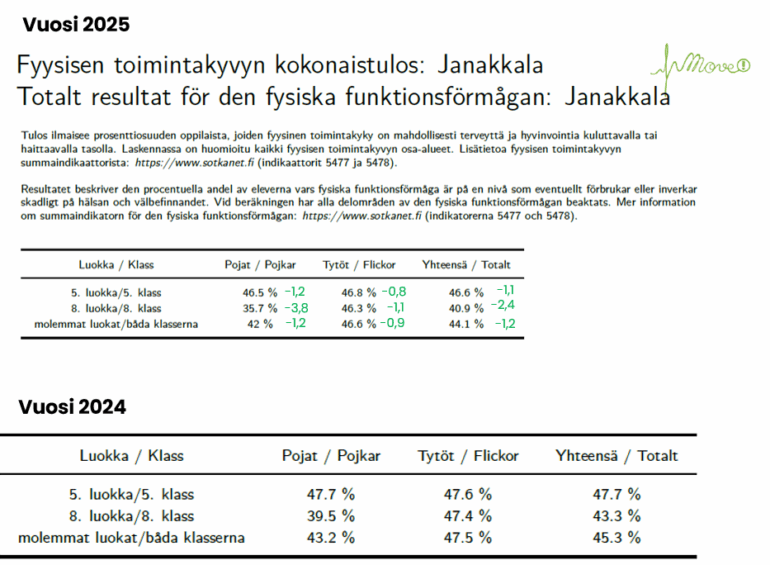
There are signs of improvement in Move! measurement results in Janakkala. The measurement results still remain largely below the national level, but positive development can be seen compared with the municipality’s own results from 2024. The development is especially positive among 8th graders. Among 5th graders just under 47 percent and among 8th graders just under 41 percent are at a level of physical functioning that may be detrimental to health and wellbeing.
Below are the changes that have occurred in the overall physical functioning results in Janakkala. The result indicates the percentage of pupils whose physical functioning is at a level that may be detrimental to health and wellbeing. All components of physical functioning have been taken into account in the calculation. The smaller the percentage, the better the situation. Unlike the national situation, in Janakkala, special attention should be paid to girls’ physical functioning.
At the national level, overall, according to the 2025 Move! results, children’s and young people’s physical functioning has slightly improved. The development is especially positive among 5th graders. Among 5th graders just under 35 percent and among 8th graders just under 40 percent are at a level of physical functioning that may be detrimental to health and wellbeing.
Physical functioning is tested across five different domains
The Move! measurements assess the following components of physical functioning: cardiorespiratory fitness, motor skills, core strength and muscular endurance, upper-body strength and mobility. The following provides a breakdown of the results by component for Janakkala based on the 2025 results
Cardiorespiratory fitness
In this test, the pupil runs back and forth over a 20-meter distance at an increasing pace guided by an audio track. The result is the total time the pupil is able to keep running at the prescribed pace. In Janakkala cardiorespiratory fitness has improved slightly among 5th-grade girls and boys, but has declined among 8th-grade girls and boys compared with the previous year. A large proportion of pupils have cardiorespiratory fitness at a level that may be detrimental to health and functional capacity. These pupils may have difficulty coping with everyday tasks without getting exhausted. In Janakkala the median result for 5th-grade girls was 3 minutes 48 seconds and for boys 4 minutes 19 seconds. For 8th-grade girls the median was 4 minutes 2 seconds and for boys 5 minutes 34 seconds. Compared with the national level, the results are worse in all age groups.
Motor skills
In the standing five-jump the pupil jumps a total of five times, making the first jump with both feet together and the subsequent jumps alternating feet. The result is the distance from the take-off spot to the landing spot. In Janakkala results for the standing five-jump have improved slightly for 5th-grade girls and boys and also for 8th-grade boys. For 8th-grade girls the result declined slightly. The median result for 5th-grade girls was 7.60 metres and for boys 7.60 metres. For 8th graders the median was 8.35 metres for girls and 9.50 metres for boys. On a national level results are on par for 5th-grade girls and 8th-grade boys, while in other age groups they are worse than the national average.
In the throw-and-catch test the pupil throws a tennis ball 20 times against a marked square on a wall and catches the ball after one bounce. During the catch the pupil may move in front of the throwing line. The result is the number of successful attempts. Compared with the previous year the throw-and-catch results have improved slightly for 5th-grade girls and boys and for 8th-grade girls. For 8th-grade boys the result has declined slightly. The median result for 5th-grade girls was 11 and for boys 12 repetitions. For 8th-grade girls the median was 12 and for boys 15 repetitions. On a national level the results are comparable for 5th-grade girls and 8th-grade boys.
Core strength and muscular endurance
In this test the pupil lies on their back with knees bent and arms alongside the body. From this position they perform as many abdominal crunches as possible in a steady rhythm guided by an audio track, with fingers sliding to the other edge of the measuring strip. The result is the number of correctly performed crunches (maximum 75 repetitions). According to the results core muscular fitness has improved in all age groups. The median result for 5th-grade girls was 26 repetitions and for boys 23.5 repetitions. For 8th-grade girls the median was 25 and for boys 39 repetitions. Compared with the national level the results are weaker in all age groups.
Upper-body strength
In this test pupils perform as many push-ups as possible within 60 seconds. For boys the support points are hands and toes, for girls hands and knees. According to the results in Janakkala upper-body strength and muscular endurance have slightly improved in most target groups, but the result has declined slightly for 5th-grade boys. The median result for 5th-grade girls was 22 repetitions and for boys 14.5 repetitions. For 8th-grade girls the median was 25 repetitions and for boys 22 repetitions. On a national level the results are on par for 8th-grade girls.
Mobility
Body mobility is assessed in three different positions that measure mobility of the pelvic region and lower limbs, range of motion in the lower back and hip area, and mobility of the upper limbs and shoulder region. Results are reported as percentages of successful performances. In Janakkala mobility for 5th-grade girls and boys has declined overall, while mobility for 8th-grade girls and boys has improved slightly compared with the previous year. Girls still have significantly better mobility than boys. For mobility the results are better than the national average for 8th-grade girls and boys.
Comparison of Move! measurement results 2025 Janakkala vs. the whole country (in Finnish)
Move! measurements in a nutshell
Move! is a monitoring and feedback system for the physical functioning of pupils in 5th and 8th grades of comprehensive education. Its purpose is to encourage children and young people to take care of their own health and wellbeing. The Move! system combines a pedagogical task, wellbeing promotion and evidence-based management.
Full summary of Janakkala municipal Move! measurement results 2025: Janakkala Move! measurement results summary (in Finnish)
Move! measurements and result categories
In the Move! framework physical functioning means the body’s ability to manage physical tasks and the goals set for it. Everyday physical tasks for schoolchildren include, for example, commuting to school under their own power and lifting and carrying school and leisure equipment.
Moving in traffic, on different terrains and surfaces and perceiving the environment and reacting to situations are also everyday physical tasks. Preventing the effects of a sedentary lifestyle and maintaining a natural anatomical range of motion are also important.
The Move! system measures pupils’ physical attributes, i.e. endurance, speed, strength and mobility. It also measures basic motor skills and perceptual-motor skills.
Results are reported by groups of 5th- and 8th-grade girls and boys. The report presents percentages of pupils belonging to different reference categories, median results and distributions of results. In autumn 2025 over 111,000 pupils were reported nationwide. Of these about 600 pupils performed the measurement in an adapted manner.
Move! results are divided into three result categories, illustrated by three different smiley faces:
- In the highest result category the measurement result is at a level that promotes health and wellbeing.
The pupil’s physical functioning supports their physical, mental and social wellbeing. - In the middle result category the measurement result is at a level that maintains health and wellbeing.
The pupil’s physical functioning maintains their physical, mental and social wellbeing. - In the lowest result category the measurement result is at a level that may be detrimental to health and wellbeing.
The pupil may have difficulties coping with everyday tasks without becoming fatigued.
Use of measurement results
Pupil and family
The pupil receives information and feedback about their own physical functioning as well as encouragement and tips for its development. Guardians receive information about their child’s physical functioning and about which issues they should pay attention to.
School health services
School nurses and doctors receive information about the pupil’s physical functioning. They can use the information in comprehensive health checks where discussions cover the child’s coping, wellbeing and factors that support or hinder learning. Move! measurement results are transferred for use in school health services with the guardian’s consent.
Teachers and the school community
Teachers and the school receive information about which components of physical functioning can be focused on in lesson planning. Results can be discussed, for example, at parent evenings and as part of different subjects’ teaching, interdisciplinary learning modules and broad-based competence. Pupils who need support can be offered, for example, club activities or other support measures to develop physical functioning.
National, municipal and regional level
Move! measurements produce information for decision-makers at the national, municipal and regional levels. The information can be used to develop and monitor national physical activity and health policy as well as health-promoting measures implemented by municipalities.
More information on Move! measurement results on the Finnish National Agency for Education website.