Blogs from the Board of Directors’
Thoughts from the pens of Janakkala’s board of directors.
1.4.2026
Heart, direction and courage – Success is born from people and boldness
Maija Nivala, Administrative and Human Resources Director
When we look at working life in 2026, we see much more than mere targets and outputs. We see people who need to be seen, and leaders whose task is to clear the path. Personnel and leadership are not separate isles; they are the shared force that carries us forward.
The fuel for this journey is the value recorded in the municipal strategy: courage.
Staff is the heart of the organization
We know that an organization’s strength is built on how well its people are doing. Automation and artificial intelligence can streamline our routines, but they cannot care, get excited, or create new things in the same way as staff can.
That is why we should always remember humanity alongside processes. Humanity also requires courage. It is the courage to be yourself, the courage to present new ideas, and the courage to speak up when something is not working. When a person feels safe, they dare to flourish. This is also called psychological safety. The goal of strengthening psychological safety has been recorded in the personnel and occupational wellbeing plan approved by the municipal executive.
Leadership is a promise and the courage to carry responsibility
For every employee to shine, we need leadership that is present. Modern leadership is about enabling and listening, but above all it is the courage to lead people.
Studies by the Finnish Institute of Occupational Health emphasize that good leadership is a key factor in building employees’ wellbeing, commitment and the organization’s success.
For a leader, courage means:
- Courage to trust: The willingness to give authority and responsibility to experts without constant control
- Courage to be vulnerable: The ability to admit one’s mistakes and learn from them together with the team
- Courage to clarify the direction: The willingness to make even difficult decisions and stand behind them, always keeping humanity in mind
Together we are more
Leadership and personnel work meet where we talk about trust. Trust is built in small everyday acts and in our willingness to meet each other genuinely. Courage is not the absence of fear, but doing the right things even when it feels uncertain.
We are not building just a workplace, but a community. When we combine good leadership, genuine care and the courage to renew, we create a foundation that will withstand all future changes.
Thank you for the shared courage
I want to thank each of you – both team members and supervisors. You make this working community wonderfully lively and brave. Let’s make sure we continue to have room for laughter, experiments and above all for each other.
16.2.2026
Do you take water services for granted? You shouldn’t
Melina Mallat, Managing Director, Janakkala Water
In Finland, drinking water is the best in the world, but securing it requires expertise, work and functioning legislation.
On my last holiday abroad, the first thing I missed from home was Finnish tap water. In many countries tap water is not drinkable and the risk of stomach illness is real. In Finland we can trust that clean and safe water will flow from the tap – every day of the year. That is a huge privilege. But maybe precisely because of that, we too easily take functioning water services for granted.
Water services are a critical basic service that enables everyday life, business activity and municipal growth. Behind it lies a broad whole: constant monitoring of water quality, proactive maintenance of networks, preparedness for exceptional situations and investments for coming decades. Most of this work is invisible. When everything works, water services go unnoticed. In a water services disruption you immediately notice how dependent we are on functioning water services.
Preparedness is especially emphasized in water services. The Water Services Act, renewed at the start of 2026, requires more precise asset management and preparedness from water utilities so that water services function in all conditions. The task of water services is to remain stable even when the economic outlook around changes.
Investments in water services are long-term work. You cannot keep increasing the repair backlog indefinitely without consequences. Networks and equipment are vital, and their condition directly affects operational reliability. That is why the finances of water services must also be planned decades ahead. Planned investments keep costs under control and prevent expensive disruptions in the future – while the municipality’s finances seek balance, water services must ensure their own stability and predictability.
Functional and reliable water services are an everyday security you don’t notice until it’s missing. It is the foundation for housing, business and construction, and it supports the municipality’s vitality even when the economic outlook is challenging. Precisely this stability makes water services an unassuming but extremely important cornerstone for the municipality.
When I missed familiar tap water on holiday, I remembered well why we do this work. Functional water services are not a given – let’s take care of them together also in the future.
14.1.2026
Do you let algorithms decide what you know?
Leena Joutsenniemi, Head of Communications
Oh those days when all of Finland gathered in the evenings to watch the same TV news and in the morning coffee tables everyone read the same local paper by region. Everyone was roughly exposed to the same information and when you placed an ad about, say, an event in that local paper, the matter became known to many.
Today it’s different.
There is an unmanageable number of communication channels, and regardless of location it is just as easy to read Financial Times stock news as local buzz. People spend up to 10 hours a day with media and social platforms, but many filter what they read and follow only topics that interest them.
Most worrying is satisfying the news hunger solely via social media. This is typical especially for the Generation Z that has grown up attached to their phones. Algorithms build a bubble tailored to each user, where it may be comfortable to live, but the worldview remains very narrow. Although in Europe the social media giants have not yet been able to give up fact-checking, the possibility of disinformation spreading is obvious, and rapidly increasing AI-generated content does not make the situation easier. Additionally, the feed fills up with ads and other suggested content instead of posts from people you follow.
For a communicator the field looks like an impenetrable jungle. How on earth do you get your messages through the jungle to the right recipients, each of whom lives in their own bubble?
The message of municipal communication also does not compete with entertainment category sexiness or with clicky headlines. Yet it may still touch a resident’s life significantly.
When it comes to municipal events, you often hear afterward: I wish I had known, why was this not announced anywhere! Well, it has certainly been announced across all channels available. But if you rely solely on an algorithm to bring everything that interests you into your feed, you miss a lot.
A practical tip about events: both Janakkala, other municipalities in the Kanta-Häme region and VisitHäme are moving to a single events calendar strategy. That events calendar is Menoinfo, which already has a link on, for example, Janakkala’s website. Take the calendar – and of course janakkala.fi – into active follow, and you’ll know what’s happening locally.
See you live – at the events!
11.12.2025
Facing harsh choices
Mika Silvennoinen, Educational Department Director
I returned to work in my former home municipality Janakkala last spring. It has felt like a spiritual homecoming, even though my physical home is elsewhere now. Many of the things I liked in Janakkala are fortunately still here. But many things have also changed compared to the early years of this century. One of the biggest changes concerns the population structure. The same phenomenon shaking economies and structures globally and nationally also affects Janakkala. The relative proportion of older people and their service needs are increasing strongly at the same time as birth rates in Finland have collapsed to 19th century levels.
It was different back in 2004 when we moved with our family to Tammiranta in Tervakoski. Our then home blocks were for several years among the fastest growing residential areas in the entire region. There were plenty of playmates for the children – almost every new yard had 2–4 children playing. Services, however, struggled to keep up with growth. When our eldest started school, the first grade had over 30 pupils, which is not ideal. Now children have left many of Tammiranta’s houses for the wider world. Based on current data, the number of comprehensive education pupils in Tervakoski will fall by more than 40 percent over the next seven years unless there is a significant change in births and migration. And because fewer children have been born in Finland in recent years, migration would need to be significant for pupil numbers to rise sufficiently. Fortunately, recent data from child health clinics offer at least a small increase even for “Terva.”
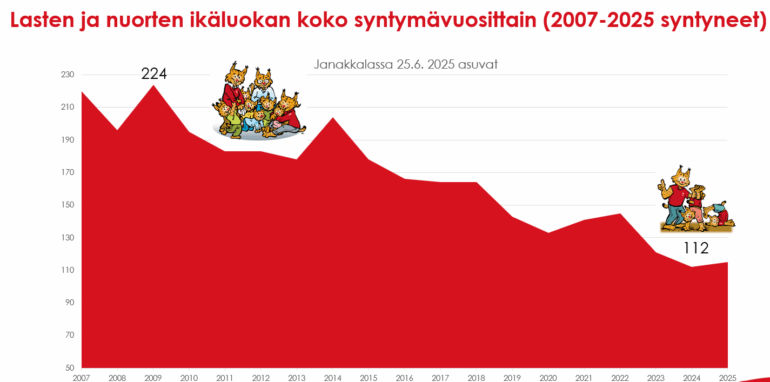
The decline in the number of children and young people is not only about Tervakoski; it challenges the entire municipality and the way we provide services. According to current information, the number of pupils in the municipality’s comprehensive education will drop by over 30% by the middle of the next decade. For now, the last of the “large age cohorts” began their school path last August and the steepness of the decline visible thereafter is comparable to the slopes of Kalpalinna.
Our national economy has just been moved to the intensive care list, our dependency ratio worries us, and parliament has agreed on a cross-governmental debt brake. It is completely clear that this development will also be felt at the municipal finance level as an even colder ride. Janakkala’s state subsidies will shrink significantly regardless due to the decrease in the number of children and young people. This challenges our revenue base in addition to the adaptation and investment needs we already face.
Now we must dare to make bold choices in line with the municipality’s new strategy both in terms of services and how they are organized. Traditionally, this debate centers on village schools and the school network. I hope for a broad discussion also about renovation investments in early childhood education, service quality, administrative digitalization and the future of non-statutory activities (e.g. open early childhood education, schools’ after-school activities, upper secondary school, adult education and music schools).
Around Christmas it feels unpleasant to be gloomy. The reason I write this is my own belief in the necessity of change. Things cannot continue as before, but the good thing is that we can also influence the future ourselves.
I therefore wish readers a good Christmas and a Year of Bold Choices 2026.
17.10.2025
Does the municipality listen? – thoughts on participation
Hanna Paikkala, Welfare Director
We want residents to be able to influence, to be heard and to feel that their opinions matter. But what does participation really mean and above all – how could we hear residents better?
Participation is not just administrative terminology; it concerns the basic prerequisites for municipal functioning, the realization of democracy and self-government. A municipality exists for its residents, and its strength is built on how well it can listen to and understand people’s everyday lives.
From hearing to meeting
Often hearing residents is thought of as the participation of the senior and disability advisory board or the youth council, feedback forms, surveys, initiatives or statements. Those are important means of realizing democracy, but the experience of participation begins only when we meet and hear people genuinely.
In recent years in Janakkala we have tried to develop ways to turn hearing into meeting. One significant development direction is UNICEF’s Child-Friendly Municipality model, which has made us pause to consider how the voices of children and young people are truly heard and visible in municipal decision-making and the organization of services.
Children and young people are residents of the municipality just like adults. Their views can sometimes surprise, but they are always wise – and always important. When you ask children and young people what makes a good hometown, recurring themes are: safety, friends, family and closeness to nature. The same themes appear in the strategic survey responses; the hometown is safe, communal, a source of pride and people want to be involved in its development.
Parents’ network – a new bridge to everyday experiences
The municipality has for a long time had a good form of cooperation with the parish regarding a network for the elderly. Local organizations have been a great resource there and communication and interaction have worked well.
As a new initiative we are building a parents’ network. Its aim is to bring together parents of children and young people of different ages to share experiences and everyday perspectives. Through the network we want to create a low-threshold channel – a place where parents can say what works and what could be improved. The network is also a way to support families in parenting, to enable and build cooperation.
Families have a strong desire to participate, but time and energy can be barriers. Therefore the network’s activities are being built flexibly – you can participate when it suits you. Participation does not require meetings or official speaking roles; it can happen electronically or in small everyday encounters.
Participation is also a feeling
Participation is also a feeling, not just structures or methods. It is the feeling that your voice is heard, that you are valued and that you can influence.
Hearing residents is not a separate project or a time-limited initiative. It is continuous learning and shared development. We are moving toward a goal where the resident is not just a user of services but an active actor – a developer of their living environment. There is a lot of tacit knowledge in the municipality – experiences, ideas and views that are found in people’s everyday lives. Strengthening participation is therefore not only a principle of democracy but also a practical way to do things better.
And perhaps that is the essence of participation: not only that people get to say their opinion, but that they feel they are part of creating the future of their hometown.
19.9.2025
Janakkala lives in its people – and each of us can be part of this story
Riikka Moilanen, Chief Executive
Janakkala is more than a place on the map. Its roots are in the soil. It is a community that carries the message of the past into the future. Few municipalities can boast as rich a history. Nature has always been part of the story here. Nature is part of people’s living environment, a breath of fresh air and routes full of memories. It offers peace, inspiration and space to breathe.
Economic life in Janakkala is diverse. Here operate both small family businesses and large industrial players. A good location between Hämeenlinna and Riihimäki, along Highway 3 and the main railway, makes the municipality an attractive place for both companies and employees. Vitality does not arise by itself and there is still plenty of collective work to do for Janakkala to grow stronger in the future.
Janakkala lives in its people – and each of us can be part of this story. Voluntary work and association activities are the heart that beats strongly in Janakkala. When we take care of our history, nature and each other, we build a municipality where everyone can feel they belong.
We are currently in the middle of big change. The population structure is changing, service needs are growing and financial resources are tightening. At the same time maintaining vitality and attractiveness as a place to live and do business requires long-term planning. For this reason a direction and common will are needed. That is why we are preparing Janakkala’s new strategy, which must not remain only a document. It is a compass that guides action, decision-making, everyday choices and the development of the municipality. The strategy gives a common direction so that we know how to make the right choices at the right time – resource-wise and listening to residents.
Preparing the strategy is an opportunity to pause and listen to residents. I hope as many as possible will take part in this open strategy preparation!
Welcome to join!